



There is no single best car for long journeys. The right one depends on who travels with you, how far you drive and, above all, how your body copes with hours in the same seat. Rather than a league table built on someone else's test drives, this guide sets out the characteristics that make a car comfortable over hundreds of miles, how to check them yourself on a test drive and where to find independent data. If you are keeping the car you already have, the last section covers what you can still improve.
What makes a car good for long-distance driving?
On a long motorway run, comfort comes from a handful of things, roughly in this order of importance for fatigue:
- The seat and driving position: support where you need it, and enough adjustment to fit your body.
- Ride quality: how suspension, wheels and tyres deal with poor surfaces.
- Cabin noise at motorway speed.
- Driver assistance in traffic and on the motorway.
- Powertrain and range: how often you stop, and how easily you refuel or charge.
- Space and boot for passengers, child seats and luggage.
Badge, power and screen size matter far less after three hours on the M6 than car adverts suggest.
Seats and driving position: check these first
The seat is where long-distance comfort is won or lost, and it is the hardest thing to judge from a brochure. Look for:
- Seat height and cushion tilt, so your hips can sit level with or slightly above your knees.
- Adjustable lumbar support. Two-way adjustment (in and out) is common; four-way adjustment also moves the support up and down, which helps if you are tall or short.
- Cushion length or an extendable thigh support, useful for long legs.
- A steering wheel that adjusts for reach as well as height, so you do not have to stretch your arms or sit too close.
- Side bolsters and armrests that hold you without pinching and let your shoulders relax.
- Heated or ventilated seats, memory settings, massage: welcome extras, not a substitute for a well-shaped seat.
Access matters too. Older drivers and seniors often find a higher seat, as in many SUVs, crossovers and MPVs, easier to get in and out of than a low hatchback. For setting up the seat once you have the car, our guide to the right driving position for sciatica walks through each adjustment, and it applies to any driver.
Ride comfort: suspension, wheels and tyres
As a general rule, larger wheels with low-profile tyres ride more firmly over potholes than the same car on smaller wheels with taller tyres, and sporty trims often add stiffer suspension. Some cars offer adaptive dampers or air suspension. When you read a road test, note the trim and wheel size that was driven: it may not be the version you are buying.
Which vehicle types suit long journeys?
| Vehicle type | Strengths for long journeys | Trade-offs to check |
|---|---|---|
| Grand tourer | Built for fast, comfortable long-distance driving; usually refined at speed | Small rear seats and boot; often expensive to buy and run |
| Estate | Large, flat boot; lower roof line than an SUV | Lower seat, harder access |
| Saloon or large hatchback | Often quiet and stable on the motorway | Boot opening can limit bulky luggage |
| SUV or crossover | High seating position, easy access, good view | More weight and frontal area: more wind noise and consumption |
| MPV / seven-seater | Spacious interior, flexible seating for families | Third-row room and boot space with all seats up |
| Entry-level hatchback or city car | Easy to park, cheap to run on long commutes | Often less sound insulation and a shorter seat base |
Noise: why a quiet cabin matters on the motorway
Constant noise makes a long drive more tiring for many people, even when they stop noticing it. Wind around the mirrors and door seals, tyre roar on coarse surfaces and engine drone all add up. Laminated acoustic glass, fitted to some cars, helps. The UK tyre label shows an external rolling noise figure in decibels, a rough guide to how noisy a tyre is. On a test drive, listen at a steady 70 mph on smooth and coarse surfaces.
Driver assistance: helpful, but you stay in charge
Adaptive cruise control, which keeps a set distance from the car in front, and lane keeping assist can take some strain out of motorway runs and queues; blind-spot monitoring helps on busy roads. These are assistance systems: you remain responsible for the car at all times. Some lane systems also intervene in a way that becomes tiring, so try them on your test drive.
For family road trips, the advanced safety features worth checking are the Euro NCAP star rating with its adult and child occupant scores, the number of seats with ISOFIX points and, if you carry three child seats, whether they fit side by side. Euro NCAP tests have become stricter over time, so compare ratings from similar years.
Petrol, diesel, hybrid or electric for long journeys?
| Powertrain | Long-journey strengths | Watch out for |
|---|---|---|
| Petrol (ICE) | Quick refuelling everywhere; suits mixed daily driving and weekend escapes | Higher fuel use on long, fast runs in larger cars |
| Diesel | Traditionally suits high-mileage motorway drivers | Older diesels can be charged in clean air zones such as London's ULEZ |
| Full (self-charging) hybrid | Very efficient in town and stop-start traffic; automatic as standard | Smaller gains on steady motorway driving |
| Plug-in hybrid | Electric for short daily trips, petrol for long ones | Mostly runs on petrol once the battery is used; you need to charge it to benefit |
| Electric vehicle | Quiet and smooth; cheap to run with home charging | Real motorway range is lower than the official figure, especially in winter; plan rapid charging stops |
Official mpg and range figures come from the WLTP laboratory test. They are useful for comparing models, whether you are looking at Honda vehicles with the best range for road trips or the best mileage from a five-seater hybrid, but real results depend on speed, temperature and load. For an electric vehicle on long highway road trips, check the charging speed from 10 to 80% and whether the rapid chargers on your routes suit it. For the best EV for a long commute in the UK, home charging and a winter range that covers your round trip with a margin matter more than the headline figure.
An automatic gearbox takes much of the effort out of queues and long commutes. Most hybrids and all electric cars are automatic; if you are comparing city cars with automatic transmission, check their refinement at motorway speed too.
Space and boot for family road trips
- Boot capacity is quoted in litres, but measured differently (to the parcel shelf or the roof, seats up or folded). Bring your own buggy or cases to the test drive.
- Rear legroom and headroom for adults or teenagers, plus air vents and charging points in the back.
- Roof bars and towing capacity if your family road trips are adventures with bikes or a caravan.
Keeping that space usable is half the battle: our guide to car accessories for long journeys covers organisers and travel kit.
How to find trusted reviews and data on family cars for long trips
- Euro NCAP for independent crash and safety-assist ratings.
- Several independent road tests by motoring titles, rather than one. Note which version was tested.
- Owner reliability surveys, such as those published by What Car? and Which?, for how models hold up over time.
- For a used car, the free GOV.UK MOT history check and vehicle recall check.
- Running costs: insurance group, road tax, servicing and tyres. The best value family car is the one that is affordable to run, not just to buy.
Planning long road trips in France, Spain, Germany or the Netherlands? GOV.UK's driving abroad guidance lists what you need in each country, including low-emission zone stickers in some French and German cities.
How to test-drive a car for long-distance comfort
- Ask for a longer test drive: some dealers offer extended or 24-hour drives, or rent the same model for a weekend.
- Set the seat, wheel, head restraint and mirrors before you move off.
- Include at least 30 minutes on a motorway or dual carriageway, plus a broken B-road.
- After half an hour, notice any pressure points, numbness or tension in your lower back or neck.
- Listen to the cabin at 70 mph and try the adaptive cruise control and lane assist.
- Get in and out several times, load the boot and sit in the rear seats.
The most comfortable car for long drives, and the best car for your lifestyle, is the one that still feels good after the second hour, not the one with the best spec sheet.
Keeping your current car? Make it more comfortable for long drives
Changing car is a big expense, and discomfort on long trips often comes down to one or two points in the seat. Comfort accessories can address them in the car you already have.
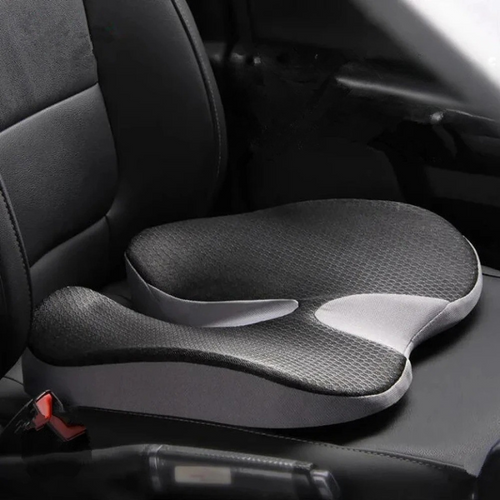
If pressure builds under your buttocks or at the tailbone, a seat cushion such as the ErgoSeat (£39.95) can help: high-density memory foam, a rear cut-out that leaves room around the tailbone, a non-slip base and a removable, washable cover.
If your seat lacks lumbar adjustment, or your neck tires on the motorway, the ErgoComfort set (£49.95) pairs a lumbar cushion with a memory-foam neck pillow, both held by adjustable straps. If the seat belt rubs your neck, the ErgoBelt pad (£19.95) sits on the shoulder strap only and must not change how the belt runs or locks. The SunShield windscreen shade (£39.95) keeps the cabin cooler when parked, never while driving.
After fitting a cushion, re-set your seat, head restraint and mirrors with the car parked, check the lap belt still sits low across your hips, and never use a seat cushion under a child or on a seat with a child car seat. Our guide to reading car seat cushion reviews helps you compare cushions honestly. And keep to the Highway Code advice: a break of at least 15 minutes every two hours, at services or a rest area, never on the hard shoulder.
Related guides: Range Rover Comfort Cushion: Seat Set-Up, Safety and When You Need One, Rolls-Royce Comfort: What Makes the Seats Work, and When a Cushion Helps and Toyota Corolla Lumbar Support: How to Set It Up and When to Add a Cushion.
Frequently asked questions
What are the leading family cars for long-distance travel?
The leading models change with each generation. Shortlist cars with a high Euro NCAP rating, an adjustable seat with lumbar support, a comfortable ride on the wheel size you will buy and a boot that takes your luggage, then compare them on a long test drive.
What hybrid cars are best for long-distance travel?
A full hybrid is easiest if you cannot charge at home, but its biggest savings come in town. A plug-in hybrid suits short daily trips plus occasional long journeys. For motorway use, compare WLTP figures with owner reports of real consumption.
Are electric cars good for long road trips?
Yes, if you plan charging stops around the real winter motorway range and the rapid chargers on your route. A charging stop every two to three hours often fits the break you should be taking anyway.


