

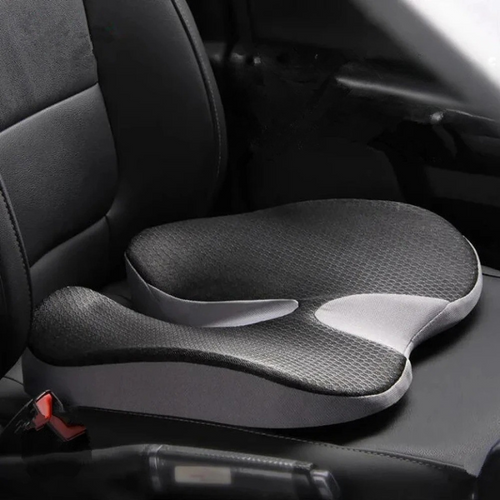


Car neck pillows are popular for long drives, but much of what is written about them overstates what they do. A neck pillow is a comfort accessory, not a safety device: it does not prevent whiplash, and it must not replace or alter your car's head restraint. Here is when one helps, when it gets in the way, and how to set up your seat so your neck stays comfortable.
Are car neck pillows safe?
For a passenger resting on a long journey, a neck pillow is generally fine, provided the head restraint is still correctly adjusted and the seat belt sits properly. For the driver, the answer is more cautious.
In a rear-end collision, the head restraint limits how far your head is thrown backwards. It works best when it is high enough and close to the back of your head. A neck pillow cannot do that job. A thick pillow strapped to the head restraint can push your head forward, away from the restraint, and can stop you setting the restraint at the right height. So no neck pillow should be bought as whiplash or crash protection, whatever the packaging says.
- Passengers: yes for resting, with the head restraint set correctly and the backrest kept fairly upright while the car is moving.
- Drivers: stay alert and rely on a properly adjusted head restraint. If you use any support, keep it thin, make sure it leaves your head free to turn, and never let it replace the restraint.
- Children: do not add pillows or padding to a child car seat unless the seat's maker approves them.
Can you use a neck pillow while driving?
There is no UK rule aimed specifically at neck pillows, but you must be able to see clearly, turn your head for mirror and blind-spot checks, and stay in full control. That rules out a few things.
- A U-shaped travel pillow worn around the neck is not suited to driving. It limits how far you can turn your head, and it is designed to hold a head that is dozing off.
- A thick or soft headrest pillow that pushes your head forward or stops the restraint being adjusted should stay with the passengers.
- If your head is starting to drop, you need a break, not support. The Highway Code (rule 91) advises that if you feel sleepy you should stop in a safe place, not on the hard shoulder or in an emergency area.
Some drivers like a slim, firm cushion at neck level on long motorway runs. If you use one, set it up before you set off, check that the back of your head still sits close to the head restraint, and leave it alone once you are moving.
Set your head restraint first
The Highway Code asks drivers to make sure head restraints are properly adjusted before setting off. Standard road-safety guidance is simple:
- Height: the top of the head restraint should be at least level with the top of your ears, or with your eyes.
- Distance: it should be as close to the back of your head as is comfortable, ideally only a few centimetres away.
- Re-check: adjust it again whenever you change the seat height, the backrest angle or add a seat cushion, and whenever someone else has driven the car.
- Rear seats too: rear head restraints are often left pushed down; raise them for adult passengers.
A head restraint left at its lowest setting often sits behind the neck rather than the head, which is the reverse of what it is for. If yours feels as though it pushes your head forward, a small change to the backrest angle usually helps more than wedging something in front of it.
Why your neck aches on long drives, and what helps more than a pillow
Neck ache in the car usually comes from the rest of your posture rather than from a lack of neck support.
- Seat position. Sit right back, with the backrest a little past upright. A backrest set far back makes you push your chin forward to see the road.
- Lower back. When the lower back slumps, the head drifts forward to compensate. Lumbar support at belt height can help the whole spine sit better.
- Steering wheel and mirrors. Set the wheel so your shoulders stay against the backrest, and the mirrors so you check them with your eyes rather than by craning.
- Seat belt. If the belt rubs your neck, adjust the upper anchor if your car has one. Any pad must sit on the shoulder strap without changing how the belt runs.
- Breaks. The Highway Code recommends at least 15 minutes after every two hours of driving. Use the stop to walk and gently roll your shoulders. Our guide to driver health on the road covers fatigue and posture in more detail.
If neck pain persists after driving, or you get pins and needles, numbness or weakness in your arms, see your GP or a physiotherapist.
When a neck pillow does help: passengers
For passengers who want to sleep, a neck pillow stops the head lolling sideways and makes resting far more comfortable. A U-shaped travel pillow works well here. Keep the backrest fairly upright while the car is moving: the seat belt is designed to work with the seat in a normal position, and a steep recline lets the body slide under the lap belt in a crash. For more passenger options, see our guide to travel pillows for car journeys.
What to look for in a car neck or headrest pillow
| Type | Best for | Suitable for the driver? |
|---|---|---|
| U-shaped travel pillow | Passenger naps | No: limits head movement |
| Thin, firm headrest pillow | Comfort on long drives | Only if the head restraint stays correctly set and the head can turn freely |
| Thick or contoured headrest pillow | Passengers resting | No: pushes the head forward |
| Inflatable pillow | Packing light for travel | No: designed for resting |
- Foam that recovers its shape rather than flattening.
- Straps that do not stop the head restraint being raised or lowered.
- A removable, washable cover.
- No claims about whiplash or injury reduction. They are a sign to look elsewhere.
ErgoComfort: lumbar cushion plus neck pillow
The ErgoComfort set (£49.95) combines a lumbar cushion that follows the curve of the back with a memory-foam neck pillow, with adjustable straps for a stable fit, with removable covers that wash at a low temperature. For most drivers, the lumbar cushion does more for neck comfort than the pillow, because it improves the posture of the whole spine. Passengers get the most from the neck pillow. As with any headrest pillow, check before you set off that it does not push your head forward or stop the head restraint being set correctly.
For other comfort items for long drives, see our checklist of car accessories for long journeys.
Frequently asked questions
Do neck pillows prevent whiplash?
No. Protection from whiplash comes from a correctly adjusted head restraint and seat. A neck pillow is a comfort accessory and can get in the way if it pushes your head forward.
Are there safety standards for car neck pillows?
Neck pillows are comfort products, not safety-rated parts of the car. The protection for your neck in a collision comes from the car's own seats and head restraints, which is why they should be adjusted correctly and never replaced or modified.
What is the best neck support for driving?
A head restraint set level with the top of your ears and close to your head, a seat set slightly past upright and good lumbar support. If you add anything, keep it thin and check it still lets you turn your head freely.
Are car neck pillows worth it?
For passengers who want to sleep on long journeys, often yes. For drivers, a better seat set-up, lumbar support and regular breaks usually do more for neck comfort.


